



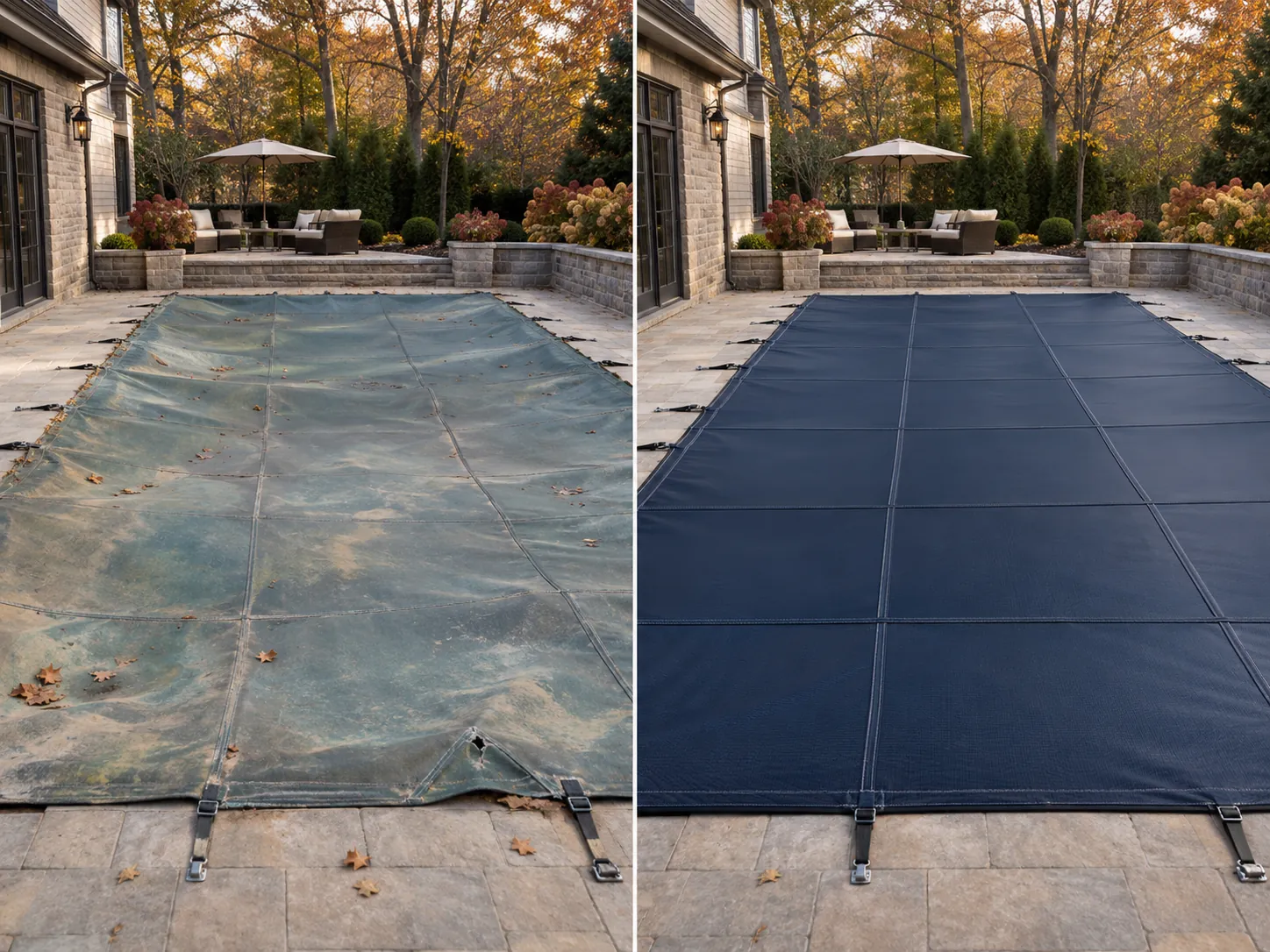
If your safety cover is more than 8 to 10 years old, surviving last winter is not proof it will survive this one. Pool safety cover replacement usually becomes necessary because of slow wear you can’t see from the patio: sun-weakened mesh, worn straps, tired springs, and loose anchors. A cover can look fine in October and give way under the first heavy snow in January.
That’s a real problem. A failed cover lets leaves and debris into the pool, makes for a rough spring opening, and most important, stops protecting kids and pets during the months the pool sits unused.
At S&R Pools, we install about 175 safety covers a year across Burlington County, South Jersey, and Bucks County, PA. Many of them replace covers that homeowners in Mount Laurel, Medford, and Cherry Hill assumed had a few more winters left. Here’s how to tell where yours stands, and what to do about it before the snow arrives.
What You’ll Learn
- How long pool safety covers last
- The real reasons safety covers wear out
- Signs your pool safety cover needs replacing
- Solution options for Burlington County and South Jersey homeowners
- Why homeowners choose S&R Pools for safety cover replacement
- Frequently asked questions
- Next steps
How Long Do Pool Safety Covers Last?
A well-made mesh safety cover that fits right and gets decent care often lasts 10 to 15 years. Solid covers usually last fewer years. Those numbers are averages, not promises, and a cover with fit or care problems can wear out much sooner. (If you’re weighing the two types, see our guide to mesh vs. solid safety covers.)
The warranty tells part of the story. Many safety cover warranties run 12 to 15 years, but only the first 2 or 3 years are full coverage. After that, coverage is prorated, so you pay a growing share of the cost. Most warranties also exclude damage from things like rough coping, low water levels during snow season, chemical exposure, tree limbs, and improper installation.
Why isn’t last winter proof? Because cover failure is usually gradual, then sudden. Each season, UV, weather, and rubbing take a little more strength out of the mesh, straps, and stitching. A mild winter puts little load on a cover. A winter with heavy wet snow and a pile of leaves puts a lot. An older cover can pass the easy test and fail the hard one.
This matters most for homeowners who:
- Have a cover 8 years old or older
- Bought the house with the cover already on it and don’t know its age
- Have a cover that’s been patched, re-strapped, or adjusted more than once
- Live on tree-lined streets in towns like Moorestown, Haddonfield, or Medford, where leaf load is heavy
The Real Reasons Safety Covers Wear Out
Before starting S&R Pools, our founder Shawn McGonagle managed the Liner & Safety Cover Design Department at a manufacturer. From the design side, we know which parts of a cover carry the load and which ones give out first. Here’s what’s really happening to an older cover.
1. Age and Sun Exposure
Safety covers spend their whole working life outdoors. UV breaks down the mesh fabric and the straps a little more every year. You’ll often see it as fading first. Faded mesh and straps are weaker than they look, and they lose the stretch that lets them absorb a heavy load without tearing.
2. Chemical Wear
A cover sits just above the water all winter, and it dips into the water whenever snow or leaves weigh it down. High chlorine levels at closing, or chemicals added through the cover, speed up the breakdown of fabric and stitching. Many warranties exclude chemical damage for this reason.
3. Rubbing on Coping and Decks
Every time the cover shifts in wind or under snow, the straps rub where they cross the coping. Rough stone and textured concrete wear through webbing faster. Over a few seasons, that rubbing thins the straps right where they need the most strength.
4. Springs and Anchors
Springs slowly lose tension, so the cover sags a little lower each year and the straps carry the load less evenly. Anchors can work loose too. On concrete decks, freeze-thaw cycles can loosen anchors over several winters. One loose anchor shifts its load onto the straps next to it.
5. How the Cover Is Stored
A cover packed away wet can grow mildew that weakens the fabric. A cover stored in a garage or shed can get chewed by mice, and many warranties don’t cover animal damage. Those holes often aren’t found until the cover goes back on in the fall.
Signs Your Pool Safety Cover Needs Replacing
On a dry day, walk the full edge of your covered pool and look for these signs:
- Faded or brittle mesh. Color loss, a stiff or papery feel, or small holes that let debris through.
- Frayed or thinned straps. Check closely where each strap crosses the coping.
- Broken or loose stitching. Look at the seams and where straps are sewn to the mesh.
- Deep sagging. The cover hangs much lower than it used to, even with little on it.
- Tired springs. Springs that stay stretched, or that no longer pull back when you release them.
- Loose or tilted anchors. Anchors should sit flush and stay put when you pull on a strap.
- Gaps along the edges or steps. Any opening where a child or pet could get under the cover.
A gap, a torn strap, or a loose anchor needs attention now. Don’t count on that cover to hold weight until it’s fixed or replaced.
One or two worn springs on a younger cover can often be swapped out. Faded mesh, worn straps, and failing stitching on a cover 8 years or older usually mean it’s time for pool safety cover replacement. And if your water level keeps dropping through the winter, that’s worth a call too. It can point to a liner leak (see how to tell if your liner will last another season), and low water leaves your cover with less support under heavy snow.
Solution Options for Burlington County and South Jersey Homeowners
What You Can Do This Winter
These steps help any cover, old or new, get through the season:
- Keep the water at the right level. Check your cover’s manual. Many mesh cover warranties call for water about 15 to 18 inches below the top of the pool. Water underneath helps support the cover under heavy snow.
- Clear heavy leaves and branches. Use a leaf blower or soft broom. Trim limbs that hang over the pool.
- Swap worn springs. Replacement springs are inexpensive and easy to change on a cover that’s otherwise in good shape.
- Tap down loose anchors so they sit flush with the deck.
What not to do: don’t walk on the cover, don’t chip at ice with a shovel or sharp tool, and don’t patch tears with tape. Each of these can make the damage worse.
Professional Pool Safety Cover Replacement
When the mesh, straps, or stitching are worn out, replacement is the real fix. We start by measuring your pool fresh using the A-B method, which plots points around the pool from two fixed reference spots. Decks get redone and features get added over the years, so we never assume the old cover’s size is still right.
Your new custom safety cover is built to those measurements. On installation day, our crew sets anchors exactly where each strap lands, using the right anchor for concrete, pavers, or stone, and sets spring tension evenly across the whole cover.
A custom safety cover from S&R Pools averages about $4,300. Your price depends on pool size and shape, mesh or solid material, deck surface, and features like steps or waterfalls. Thinking about a cheaper stock cover instead? Here’s why a $2,000 cover online can cost you more in the long run.
Keep It or Replace It?
| What you’re seeing | Our recommendation |
| Cover under 8 years old, one or two tired springs | Replace the springs and keep watching it |
| Faded mesh, no tears, straps still solid | Plan a replacement for next season |
| Frayed straps, broken stitching, or brittle mesh | Replace before relying on it through heavy snow |
| Gaps at the edges or loose anchors | Tap anchors flush now; gaps usually mean the cover needs replacing |
| Cover age unknown and showing wear | Get a free estimate so you know your options |
Timing This Time of Year
Custom covers are built to order after we measure, so the best time to replace is before you close the pool. If you’re reading this with your pool already closed and your cover in rough shape, call us anyway. We’ll tell you honestly what’s possible this season, and help you get on the schedule early for next fall.
Why Homeowners Choose S&R Pools for Safety Cover Replacement
S&R Pools, LLC has served homeowners from our home base in Columbus, NJ since 2009. Liners and safety covers are all we do, so every tool and process we use is built around getting them right.
- Manufacturer-level design knowledge. Our founder ran a liner and safety cover design department before starting S&R Pools.
- High volume, fewer surprises. We install about 175 safety covers and 200 liners every year, from Lumberton and Cinnaminson to Robbinsville, Manalapan, and Yardley.
- Merlin Authorized Dealer. Quality materials and clear, honest pricing.
- Real accountability. Our promise is simple: Done Right. Or We Make It Right.
Frequently Asked Questions
How long do pool safety covers last?
A well-fitted mesh safety cover with good care often lasts 10 to 15 years. Solid covers usually last fewer years. Poor fit, rough coping, high chemical levels, and storage damage can shorten that a lot, so age alone doesn’t tell the whole story.
How much does pool safety cover replacement cost?
A custom safety cover from S&R Pools averages about $4,300, measured and installed. Your price depends on pool size and shape, mesh or solid material, deck surface, and features like steps or waterfalls. We give free estimates so you know your number before you decide.
How do I know if my pool safety cover needs replacing?
Look for faded or brittle mesh, frayed straps, broken stitching, deep sagging, tired springs, loose anchors, and gaps at the edges. If your cover is 8 years or older and shows more than one of these, it’s time to plan a replacement.
Can an old safety cover be fixed instead of replaced?
Small parts like springs can be swapped on a cover that’s otherwise in good shape. Once the mesh, straps, or stitching are worn out, fixing one spot usually just moves the stress to the next weak spot. That’s when replacement makes more sense.
Do you measure my pool again for a replacement cover?
Yes. Decks get redone and features get added over the years, so we measure every pool fresh. That way your new cover fits the pool you have today, not the one the old cover was made for.
Can I replace my safety cover in the winter?
Custom covers are built to order, so timing depends on the season and our schedule. Call us and we’ll tell you honestly what’s possible now, and help you get on the schedule early for next fall if waiting makes more sense.
What should I do if my safety cover fails during the winter?
Keep kids and pets away from the pool and don’t walk on the cover. Then call us so we can talk through your options.
What areas does S&R Pools serve?
We serve Burlington, Mercer, Camden, Monmouth, Middlesex, and Ocean Counties in New Jersey, plus Bucks County, PA. We do not serve Philadelphia or Trenton.
Next Steps
- Surviving last winter doesn’t mean an older cover will survive a harder one.
- Sun, chemicals, rubbing, tired springs, and storage damage all weaken a cover over time.
- Gaps, frayed straps, and loose anchors need attention now.
- A custom replacement cover averages about $4,300 and is built for the pool you have today.
Not sure how much life your cover has left? Contact S&R Pools for a free estimate. Call 609-310-1495, email info@srpoolsllc.com, or fill out our form. We’re available Monday through Friday, 9:00 AM to 5:00 PM, and serve Burlington, Mercer, Camden, Monmouth, Middlesex, and Ocean Counties in NJ, plus Bucks County, PA.