




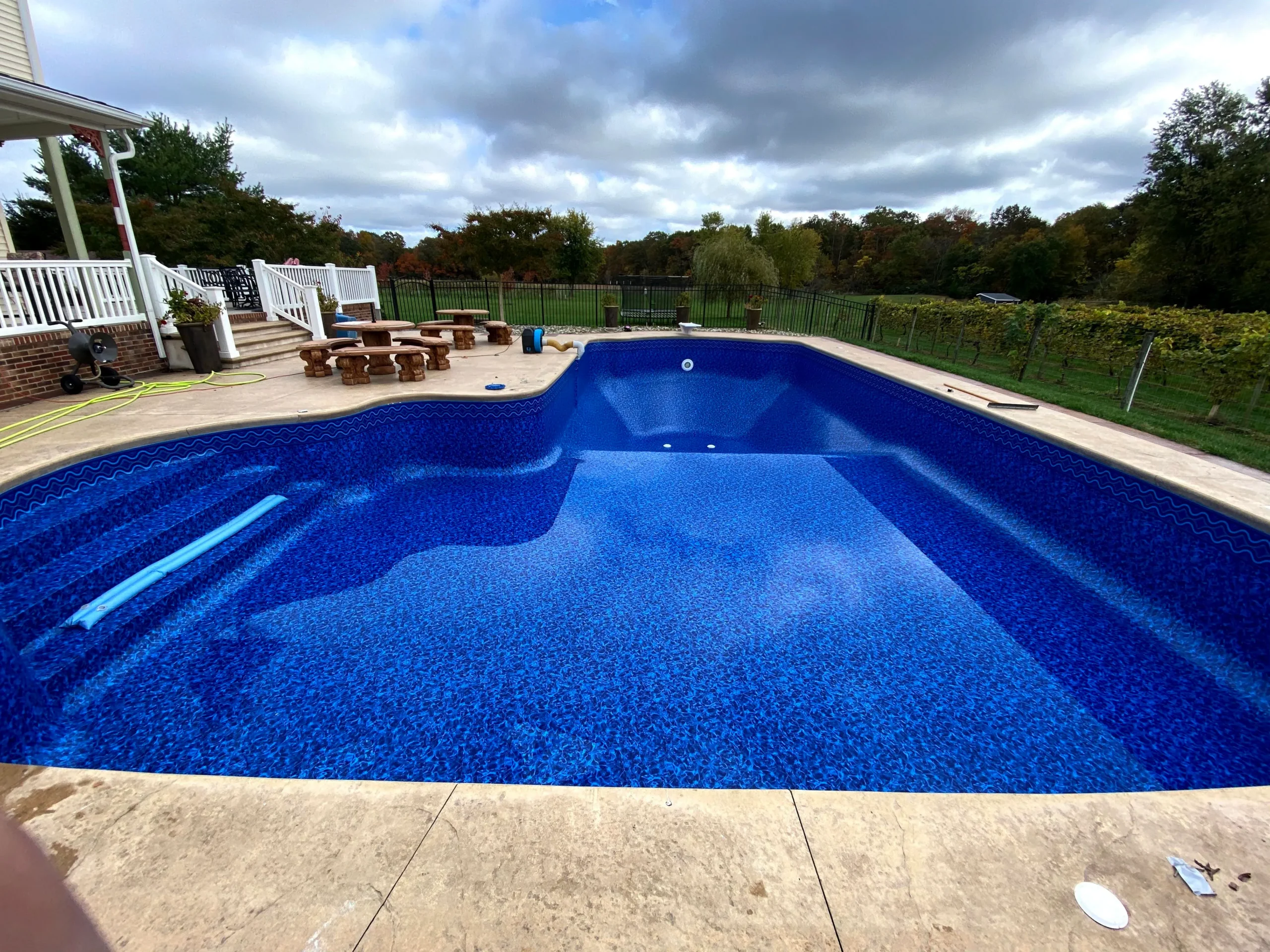
Your pool got you through another summer of weekends, cookouts, and cannonballs — but now that the season’s winding down, you’re looking at that liner and wondering if it has one more year in it. Understanding pool liner lifespan is the key to answering that question before you’re stuck making an emergency call next spring. In my 16+ years installing vinyl liners across Central New Jersey, I’ve seen plenty of liners that looked “fine” in September fail by May. This guide walks you through exactly how to tell whether your liner is ready for another season — or whether now is the smart time to plan a replacement.
How Long Does a Pool Liner Actually Last?
The typical pool liner lifespan for an in-ground vinyl liner runs somewhere between 8 and 12 years, though real-world results vary quite a bit. Some liners tap out closer to year six or seven; others, with good water chemistry and a bit of luck, stretch past a decade.
When people ask how long pool liners last, the honest answer is: it depends on how the liner was cared for and the conditions it lived through. A liner isn’t a fixed-expiration part — it’s a piece of vinyl that ages based on:
- Water chemistry and chemical exposure over the years
- Sun and UV exposure
- How often the pool was used
- Groundwater conditions around the pool
- The quality of the original installation
So while the 8-to-12-year range is a useful benchmark, the better question isn’t “how old is my liner?” It’s “what shape is my liner in right now?” That’s what the rest of this article helps you figure out.
What Shortens a Vinyl Pool Liner’s Lifespan
A vinyl pool liner lifespan rarely ends because of a single dramatic event. More often, it’s the slow accumulation of everyday wear. Understanding these causes helps you spot trouble early — and it explains why two pools on the same street can be on very different timelines.
Chemical Wear Over Time
This is the big one. Chlorine, pH swings, and years of chemical balancing gradually break down the vinyl’s flexibility. The material that started out soft and stretchy slowly becomes stiffer and more brittle. Water that ran too hot on chemicals for a season or two can accelerate this dramatically. An aging pool liner that’s spent a decade absorbing chemicals simply loses the give it needs to stay sealed and wrinkle-free.
Sun and UV Exposure
The waterline and exposed areas take a constant beating from UV rays. Over years, that sun exposure fades the pattern and weakens the top layer of the vinyl, which is why a faded pool liner is often a sign the material underneath is tired, too.
Simple Age and Long-Term Use
Vinyl doesn’t last forever. Even a well-maintained liner reaches a point where years of stretching, contracting, and general use have used up its working life. High-use pools naturally reach that point sooner.
Groundwater Conditions
Groundwater pressure behind the liner can cause it to shift, float, or wrinkle — especially during the off-season or after heavy rain. This isn’t a chemistry problem; it’s what’s happening in the ground around your pool. When groundwater gets behind a liner, it can pull the material away from the walls and create wrinkles that weren’t there before.
In our experience installing roughly 200 liners a year, the liners that fail earliest almost always trace back to chemical wear, sun damage, or groundwater — not to any single catastrophe.
Fading and UV Damage
One of the first visible signs of a liner nearing the end of its pool liner lifespan is fading. Look at the pattern near the waterline versus down toward the floor. If the top has gone pale, washed-out, or noticeably lighter than the bottom, UV exposure has been steadily working on the vinyl.
Fading itself won’t sink your pool. But a faded pool liner tells you the material has spent years in the sun and is likely losing strength. Faded vinyl is often thinner and more brittle than it looks, which means it’s closer to cracking or tearing than a liner that still holds its color. Think of fading as your liner’s way of showing its age.
Cracks, Brittleness, Stretching, and Wrinkles
This is where a liner tells you loud and clear that its vinyl pool liner lifespan is running short. Run through these checks:
- Brittleness: Gently press the liner above the waterline. Vinyl in good shape flexes and springs back. A cracked or brittle pool liner feels stiff, hard, or crinkly — a sign the material has lost its elasticity from years of chemical and sun exposure.
- Cracks and splits: Look closely along the waterline and any exposed areas for small cracks, splitting, or flaking. These don’t heal, and they tend to spread.
- Stretching: A stretched liner may pull away from the walls or fail to sit snugly in the corners the way it used to.
- Wrinkles: New wrinkles that weren’t there last year often point to groundwater behind the liner or a liner that’s stretched and lost its fit. Once a liner starts wrinkling, it rarely tightens back up on its own.
Among the clearest signs a pool liner needs replacing, brittleness and cracking sit at the top. A liner that’s gone stiff won’t survive the stress of another opening and closing cycle without a high risk of tearing.
Leaks and Unexplained Water Loss
If you found yourself topping off the pool more than usual this summer, your liner may be trying to tell you something. Pool liner leaks are one of the most common reasons homeowners realize a replacement is coming.
Some water loss is normal — evaporation is real, especially in hot, dry stretches. But if you’re losing more than about a quarter to half an inch a day consistently, and it’s not just evaporation, a compromised liner is a likely culprit. Small cracks, worn spots, or failures around fittings can let water slip out slowly and steadily.
Unexplained water loss on an older liner is rarely a coincidence. On an aging pool liner, a leak usually means the material or its seals have worn to the point where patching is a short-term fix at best.
Trouble Around Fittings, Steps, Corners, and Seams
The liner’s weak points are wherever it has to bend, seal, or connect to something. As a liner ages, these are the spots that give out first:
- Fittings (skimmers, returns, lights): Look for gaps, lifting, or worn vinyl where the liner meets these openings. Seals around fittings loosen as the vinyl stiffens.
- Steps and corners: These high-stress areas show stretching and pulling-away sooner than flat walls. If your liner no longer hugs the steps or corners tightly, it’s stretched.
- Seams: Check where sections of the liner join. Seam separation on an older liner points to a material that’s simply worn out — not a temporary issue you can wait out.
When multiple trouble spots show up at once, that’s a strong signal your liner has reached the end of its useful life. A single worn fitting might buy you time; widespread issues around fittings, steps, and seams usually don’t.
How to Decide If Your Liner Can Last Another Season
Here’s a simple way to weigh it. Walk your pool and tally what you find:
Probably good for another season:
- Minor fading, but the vinyl still feels flexible
- No cracks or brittleness
- Snug fit at walls, steps, and corners
- No unexplained water loss
Time to seriously plan a replacement:
- Brittle, stiff, or cracking vinyl
- Persistent pool liner leaks or steady water loss
- New wrinkles or stretching that won’t tighten up
- Worn or separating seams and fittings
- A liner already 8–12+ years old showing several of the above
If you’re seeing two or three of the warning signs together — especially on a liner that’s already near the far end of its typical pool liner lifespan — the smart move is to plan ahead rather than gamble on it holding. A liner that fails mid-season means a rushed timeline and a pool you can’t use during the best weeks of summer.
The end of the swimming season is honestly the ideal time to make this call. You’re not under pressure, installation calendars have more room, and you can walk into next spring with a pool that’s ready to go.
When to Schedule a Professional Liner Replacement
When the signs point to the end of your liner’s life, a professional pool liner replacement restores a perfect, custom-measured fit and protects the structure of your pool underneath. At S&R Pools, we measure each pool precisely, help you choose the right pattern, and complete most liner replacements in a single day — transforming your backyard without dragging the project out for weeks.
Because vinyl liners and safety covers are all we do, every tool, process, and step is built around getting the fit right. Our founder managed the Liner & Safety Cover Design Department at a leading manufacturer before starting S&R Pools in 2009, which means your liner is installed to the standard it was engineered for. And it’s all backed by our guarantee: Done Right. Or We Make It Right.
If you’re not sure where your liner stands, we’re glad to take a look and give you an honest, no-pressure free estimate — whether that’s this fall or when you’re planning for spring.
Frequently Asked Questions
How long does a vinyl pool liner last? Most in-ground vinyl pool liners last between 8 and 12 years. The actual pool liner lifespan depends on water chemistry, sun exposure, groundwater conditions, and how heavily the pool is used. Well-maintained liners often reach the higher end of that range.
How do I know if my pool liner needs to be replaced? Watch for brittleness, cracking, heavy fading, new wrinkles, unexplained water loss, and worn or separating seams and fittings. When several of these signs a pool liner needs replacing show up together — especially on an older liner — it’s time to plan a replacement.
Is fading alone a reason to replace my liner? Not on its own. A faded pool liner is mostly cosmetic, but it signals years of UV exposure that often leaves the vinyl thinner and more brittle underneath. Fading is a heads-up to inspect the liner more closely, not an automatic replacement trigger.
Why is my pool losing water? Some loss is normal evaporation. But steady, unexplained water loss on an aging pool liner often points to leaks from small cracks, worn spots, or failing seals around fittings. On an older liner, this usually means replacement rather than patching.
How much does a pool liner replacement cost? Pricing depends on your pool’s size, shape, and the liner you choose. At S&R Pools, vinyl liner replacements start at approximately $4,750. We provide a clear, free estimate up front so you know exactly what to expect.
How long does a liner replacement take? Most vinyl liner replacements are completed in a single day. We handle the precise measuring, material selection, and installation so your backyard is transformed quickly.
When is the best time to replace a pool liner? The end of the swimming season and the off-season are ideal. Scheduling ahead means you avoid the spring rush and start next summer with a pool that’s ready to use.
What areas does S&R Pools serve? S&R Pools serves homeowners across Burlington, Mercer, Camden, Monmouth, Middlesex, and Ocean Counties in New Jersey, plus Bucks County, PA.
Next Steps
If summer left you wondering whether your liner has one more season in it, here’s the bottom line:
- A typical pool liner lifespan runs 8–12 years, but condition matters more than age
- Brittleness, cracks, leaks, and worn seams are the clearest signs it’s time
- The off-season is the best time to plan a pool liner replacement and beat the spring rush
- An honest look now saves you a rushed, mid-summer emergency later
Not sure where your liner stands? Contact S&R Pools for a free, no-obligation estimate. Call 609-310-1495, email info@srpoolsllc.com, or fill out our form. We’re open Monday–Friday, 9:00 AM – 5:00 PM, and we serve homeowners across Burlington, Mercer, Camden, Monmouth, Middlesex, and Ocean Counties in NJ, plus Bucks County, PA.


Comments are closed