




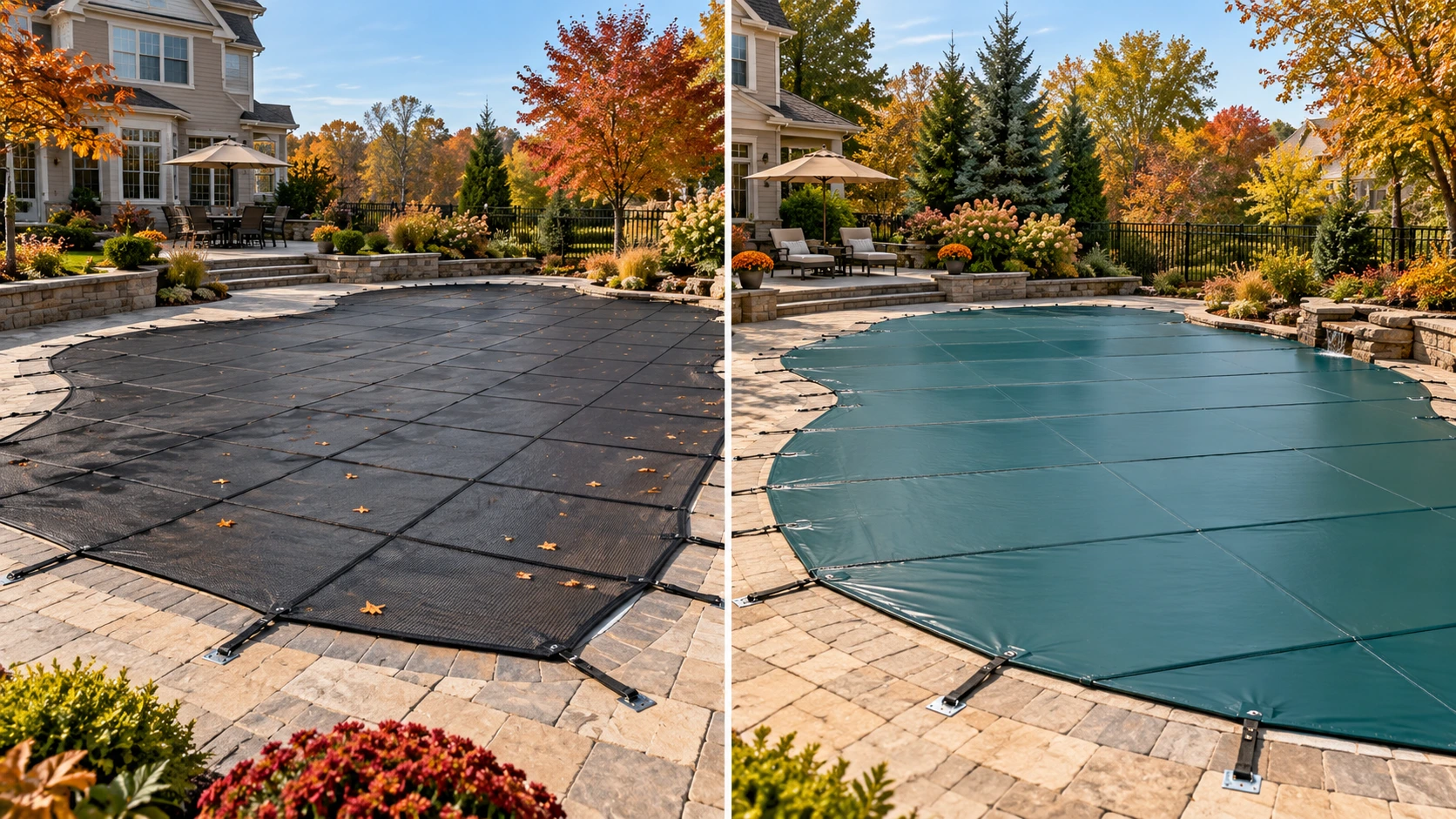
Mesh or Solid? The Short Answer
Choosing between a mesh vs solid pool cover comes down to one question: what do you want to deal with next spring? A mesh safety cover drains rain and melting snow on its own, but it lets some sunlight and fine dirt reach the water. A solid safety cover blocks nearly all sunlight and debris, but water collects on top and has to be pumped off.
Both types protect your family when they are built to the ASTM F1346 safety cover standard and installed correctly. Each one is designed to hold the weight of a child or pet and keep them out of a closed pool.
If you can’t decide, you’re in good company. Many homeowners in Burlington County and South Jersey pick a cover on price alone, then open the pool in May to green water or a cover sagging under a pond of rainwater. At S&R Pools, LLC, we install about 175 safety covers every year, and our founder designed them at the manufacturer level before starting the company. This guide walks you through how to pick the right one for your yard.
What You’ll Learn
- What Is the Mesh vs. Solid Pool Cover Decision?
- Why the Wrong Cover Causes Problems
- How to Tell Which Cover Fits Your Pool
- Mesh vs. Solid Pool Cover: Your Solution Options
- Why Burlington County Homeowners Choose S&R Pools
- Frequently Asked Questions
- Next Steps
What Is the Mesh vs. Solid Pool Cover Decision?
A safety cover is a custom-made cover held tight over your pool by straps, springs, and anchors set into your deck. It stays on from fall closing until spring opening, which in New Jersey is often six or seven months. The mesh pool cover vs solid pool cover choice decides what happens to rain, sunlight, and debris during that whole stretch.
There are two main families:
- Mesh safety covers are a tight woven fabric. Water passes through, and leaves stay on top.
- Solid safety covers are a heavier coated material. Nothing passes through, including water. Some solid covers add a mesh drain panel in the middle so rain can drain.
Signs your current cover may be the wrong type for your yard:
- Green or cloudy water every time you pull the cover
- A layer of fine dirt or pollen on the pool floor at opening
- A pond of water and wet leaves sitting on the cover all winter
- A cover pump that clogs or quits during storms
- Big chemical bills just to get the water clear in spring
This matters because a safety cover lasts many years. The type you pick is one you will live with for a long time.
Why the Wrong Cover Causes Problems
Most cover frustrations trace back to four things: water, sunlight, debris, and how much attention you can give the pool in the off-season. Each cover type handles them differently.
Water: Where Does the Rain Go?
A mesh cover lets rain and snowmelt drain right into the pool. That keeps weight off the cover, but your water level rises over the winter, and you may need to lower it before opening. A solid cover holds all that water on top. Unless a pump or drain panel removes it, the water adds weight and pulls hard on the springs and anchors. In our experience, a solid cover without a reliable way to shed water is the setup that gives homeowners the most trouble.
Sunlight: Why the Pool Turns Green
Standard mesh lets some sunlight through. On warm spring days, that light plus the nutrients in the water can start algae growth before you open. A solid cover blocks nearly all light, so the water usually comes out cleaner. Higher-density mesh covers block much more light than standard mesh and close a lot of that gap. Clearing a green pool takes heavy chemical treatment, and harsh chemistry over time is hard on vinyl liners.
Debris: What Falls From Your Trees
Both covers keep leaves, sticks, and needles out of the pool. The difference is the small stuff. Mesh lets fine dirt, pollen, and leaf stain wash through with the rain. On wooded lots in Medford, Moorestown, and Shamong, with oaks overhead and pine needles all around, that can mean a dirty pool floor in spring. A solid cover keeps it all on top, but you have to clear that debris before the cover comes off.
Upkeep: How Often Will You Check the Pool?
A mesh cover needs very little attention between fall and spring. A solid cover needs someone to watch the pump and clear standing water after heavy rain or snow. If you travel in winter or just don’t want another chore, that matters as much as anything else.
How to Tell Which Cover Fits Your Pool
Answer these six questions honestly. Your answers point to the right cover type.
- How many trees are near the pool? Heavy tree cover favors solid or higher-density mesh, since they keep more fine debris out of the water.
- How did your last opening go? Green water every spring points toward solid or higher-density mesh.
- Will someone check the pool after winter storms? If not, mesh is the safer choice because it drains on its own.
- Do you want to deal with a cover pump? If not, choose mesh or a solid cover with a mesh drain panel.
- Who will take the cover off and store it? Mesh is lighter and easier to fold. Solid covers are heavier, especially when wet.
- What is your budget? Standard mesh costs the least. Solid covers cost more.
If low upkeep and cost matter most, mesh is likely your fit. If clean water at opening matters most and you can manage water on top, solid is worth a close look.
Whatever you choose, a safety cover is custom-made for your pool. The measuring and anchor layout should be done by a specialist, and that’s where a free estimate from S&R Pools comes in.
Mesh vs. Solid Pool Cover: Your Solution Options
Here are the solid vs mesh pool cover pros and cons side by side, including the two in-between options.
| Cover type | Drains water on its own | Blocks sunlight | Keeps out fine dirt | Off-season upkeep | Weight | Relative cost |
| Standard mesh | Yes | Partly | Partly | Very low | Lightest | Lowest |
| Higher-density mesh | Yes | Most | Most | Very low | Light | Moderate |
| Solid with mesh drain panel | Yes, through the panel | Most | Most | Low to moderate | Heavy | Higher |
| Solid (no drain panel) | No, needs a cover pump | Nearly all | Nearly all | Moderate | Heaviest | Higher |
What You Can Do Yourself
With the cover you have now, a few simple habits help:
- Clear leaves off the cover with a leaf blower or soft broom so they don’t break down into the water.
- On a solid cover, keep the pump intake clear and remove standing water after big storms.
- Check that every spring is seated in its anchor and the cover sits evenly.
What not to do: never swap in a basic winter tarp or water-bag cover and treat it like a safety cover. It won’t stop a child or pet. And don’t try to measure for a cover or drill anchors yourself. One misplaced anchor can leave a gap or put uneven pull on the cover.
What Professional Installation Includes
A proper safety cover install starts with exact measurements of your pool and every feature around it, like steps, raised walls, rock features, and diving board bases. The cover is then built to that layout. On install day, we set anchors into your concrete, pavers, or stone, attach the springs, and adjust the tension so the cover sits tight and even.
Safety covers we install average about $4,300. Your price depends on pool size and shape, the cover type, and your deck. Solid covers typically cost more than mesh.
Every install is backed by our guarantee: “Done Right. Or We Make It Right.” If something doesn’t fit, we fix it. No finger-pointing between the manufacturer and the installer.
Why Burlington County Homeowners Choose S&R Pools
S&R Pools, LLC has installed liners and safety covers since 2009, and covers are a core part of what we do. That focus shows up in the details.
- Design-level knowledge. Our founder, Shawn McGonagle, managed the Liner & Safety Cover Design Department at a manufacturer. We know how covers are engineered and where they fail.
- High volume. About 175 safety covers a year means our crews have seen nearly every pool shape and deck type.
- Merlin Authorized Dealer. Merlin builds both mesh and solid safety covers, so we can recommend what fits your yard instead of pushing one product.
- Straight answers. If standard mesh is the better fit for you, we’ll say so, even though solid costs more.
We serve homeowners from Columbus, Bordentown, and Mount Laurel to Cherry Hill, Haddonfield, Princeton, Robbinsville, Freehold, and Yardley, PA.
Frequently Asked Questions
What is the difference between a mesh and solid pool safety cover?
A mesh cover is a woven fabric that lets water drain into the pool while keeping leaves out. A solid cover is a heavier material that blocks water, sunlight, and debris. Mesh needs less upkeep. Solid usually gives you cleaner water at opening but needs a way to remove water from the top.
What is the best pool safety cover for a pool surrounded by trees?
It depends on how much upkeep you want. Solid covers and higher-density mesh keep the most fine debris and leaf stain out of the water. If you won’t be around to clear standing water, higher-density mesh is often the best balance for wooded lots in Medford, Moorestown, and nearby towns.
Do solid safety covers need a pump?
Yes, unless the cover has a mesh drain panel. Rain and melting snow collect on a solid cover, and that water has to come off. Most homeowners use an automatic cover pump. A drain panel lets water pass through on its own, which removes the need for a pump in most cases.
How much does a safety cover cost in Burlington County?
Safety covers installed by S&R Pools average about $4,300. The final price depends on your pool’s size and shape, the cover type, and your deck surface. Solid covers typically cost more than mesh. We offer free estimates so you get a clear number before you decide.
How long do mesh and solid safety covers last?
Lifespan depends on the material, sun exposure, and care. Quality covers last many years when they are kept clean and stored dry during swim season. Mesh covers often outlast solid covers because water never sits on them. Your cover’s warranty is a good guide to how long the manufacturer expects it to last.
Can a safety cover be installed on pavers or stone?
Yes. Safety cover anchors can be set into concrete, pavers, and natural stone. Each surface needs the right drilling method and anchor placement so the deck isn’t damaged and the cover pulls evenly. Our crews install on all three surfaces regularly.
When should I order a safety cover?
Every safety cover is custom-made, so plan ahead. Many homeowners schedule in late summer so the cover is ready for fall closing. Spring works too if you want a new cover in place before next season. Call early, since fall is one of our busiest times.
Next Steps
The key points to remember:
- Mesh drains on its own and needs the least upkeep.
- Solid blocks sunlight and fine debris but needs a pump or a drain panel.
- Higher-density mesh and solid covers with drain panels sit in between.
Not sure which one fits your pool? S&R Pools will measure your pool, walk you through the options, and give you a free estimate with no pressure. Call 609-310-1495, email info@srpoolsllc.com, or use the form. We’re available Monday through Friday, 9:00 AM to 5:00 PM.
We serve Burlington, Mercer, Camden, Monmouth, Middlesex, and Ocean Counties in New Jersey, plus Bucks County, PA.



Comments are closed